
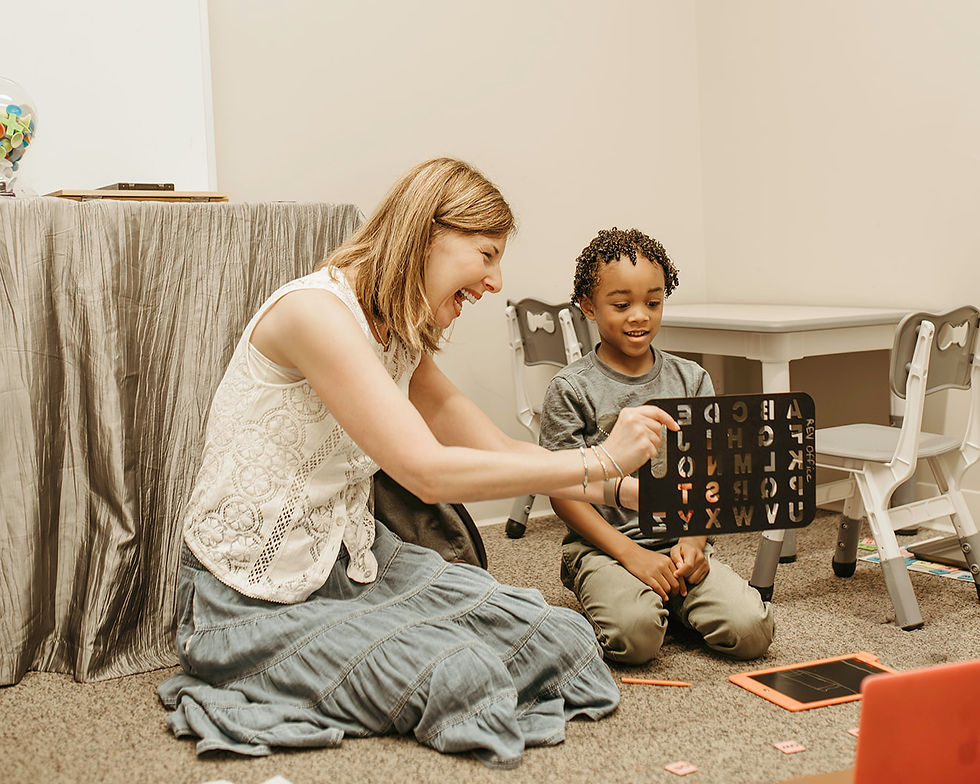
Reach Every Voice is a team of educators with decades of experience providing AAC instruction for nonspeaking and partially speaking autistic learners in Maryland. We offer one-on-one communication instruction, adapted grade-level curriculum, communication partner training, professional development for educators, and school consultation. Our practices draw from multiple evidence-based strategies, centered on a text-based, multimodal AAC approach that meets each learner where they are
Some communication approaches prescribe a rigid, step-by-step recipe for using their tools and instructional methods. At Reach Every Voice, we take a different path. Our practices are informed by multiple evidence-based strategies, drawing from a variety of sources to meet each learner where they are.
We know every student is unique — and most communicate in multiple and varied ways. That’s why our instruction centers on a text-based, multimodal AAC approach, empowering learners to express themselves authentically, confidently, and effectively.
Rooted Here. Reaching Further.
REV AccessAbility is a 501(c)3 non-profit organization that has supported text-based multimodal communication since 2017.
We strive to provide access to more training, coaching, and practice opportunities and to work to make these more affordable for all stakeholders.

.png)
.png)
.png)

.png)


![Are you listening to nonspeakers?
They are sharing their realities, refuting the incorrect things being declared about them.
We're doing our best to amplify their voices.
You can join us in this effort by sharing Ryan's poem.
Ryan, thank you for sharing your voice with us!
Actually nonspeakers
Making changes
Please Listen to us
Learn from my mind
I have so much to say
Feeling isolated is not an option
You know we can hear
[id: a photo of Ryan wearing a hoodie and smiling at the camera. He is sitting in the open back of his car, which is decorated with balloons and ghosts for a trunk or treat event. The words of Ryan's poem are printed on the photo]](https://scontent-den2-1.cdninstagram.com/v/t39.30808-6/835873807_1752246243570982_7214582459906733331_n.jpg?stp=dst-jpg_e35_tt6&_nc_cat=111&ccb=7-5&_nc_sid=18de74&efg=eyJlZmdfdGFnIjoiRkVFRC5iZXN0X2ltYWdlX3VybGdlbi5DMyJ9&_nc_ohc=TX_3YeWG7vAQ7kNvwHLYWO7&_nc_oc=AdowC_HygZ69EmWXod-wjdXbMGTT30_XApZnT-RDObwMm7Oln72UuuI6VsZm-qUDLZk&_nc_zt=23&_nc_ht=scontent-den2-1.cdninstagram.com&edm=ANo9K5cEAAAA&_nc_gid=NskFOFONyvZ_by_sxpZ7OA&_nc_tpa=Q5bMBQJnsOA-rUXXdX1CyQeU9jKAe3XFCFzkPcSljjSK_rEBotAYP3Q3uP4jZe4JR8BKNZE4YMY2gNo-&oh=00_AQM4ViBoX1rnUOJ2Do9JQ0_r9gvWfADFVjcpXgcx5O9OaQ&oe=6AE61037)

![Have you ever looked at an IEP's present levels or a report with assessment results and felt they were just SO WRONG? That they didn't reflect the kid you know?
The first question we always ask when viewing present levels or any assessment results is, "did they have access to a reliable form of communication when they were asked to demonstrate this knowledge?"
If the answer is no, then that "information" in the document really tells us nothing.
We have no idea what a child is capable of learning unless information is presented in a way that is accessible to them and they have a reliable way to communicate their understanding.
Communication is at the core of everything.
Communication is a human right.
[image ID: a two-tone teal graphic of a speech bubble. The words printed on top say, "We have no idea what a child is capable of learning unless information is presented in a way that is accessible to them and they have a reliable way to communicate their understanding." The Reach Every Voice logo is in white at the bottom right of the image.]](https://scontent-den2-1.cdninstagram.com/v/t39.30808-6/833276513_1752230370239236_4937191047953622242_n.jpg?stp=dst-jpg_e35_tt6&_nc_cat=111&ccb=7-5&_nc_sid=18de74&efg=eyJlZmdfdGFnIjoiRkVFRC5iZXN0X2ltYWdlX3VybGdlbi5DMyJ9&_nc_ohc=aF69q_l5DcQQ7kNvwETcLOO&_nc_oc=AdpdDWCcOcuC7g0iKCKcauHADfxORZpoO9APSiLZj2OuWEEYNJ9T4HC0QUh5tj0a7o4&_nc_zt=23&_nc_ht=scontent-den2-1.cdninstagram.com&edm=ANo9K5cEAAAA&_nc_gid=NskFOFONyvZ_by_sxpZ7OA&_nc_tpa=Q5bMBQKOIq0E3el_yn_-Z1NTz2tKIQ_9gJd2nJ_0hDw3dtAVBq4tRcuaDXnMsYSTzJzhCA164-DQElnX&oh=00_AQO81ABUhujwyMASQScTdx8DVdnzrB7mpGGkz0cDWk02Fg&oe=6AE6289E)
![Autistic voices must be heard!
The first line of Casey's acrostic poem says it all. We're proud to continue to amplify our students' words. We invite you to share these posts to help us broaden their reach.
Autistic voices must be heard.
My life has changed with a pencil and stencils.
Please know I need this community to survive.
Learning happens when you open your ears.
I am ready for big changes.
Finding myself through spelling.
You have the ability to accept.
Casey
REV Student
[id: a photo of Casey, a young person with glasses, short dark hair, and a deep blue shirt on a sunny day with clear blue skies at the beach. Casey is standing where the waves meet the shore, turning to smile at the camera. The words from Casey's acrostic poem are printed on the image.]](https://scontent-den2-1.cdninstagram.com/v/t39.30808-6/834438731_1752222673573339_1006093093995022142_n.jpg?stp=dst-jpg_e35_tt6&_nc_cat=107&ccb=7-5&_nc_sid=18de74&efg=eyJlZmdfdGFnIjoiRkVFRC5iZXN0X2ltYWdlX3VybGdlbi5DMyJ9&_nc_ohc=WD14_C5iG10Q7kNvwElWmqq&_nc_oc=AdrP3E5KZ1B1-X5S8o2KOzZ6uqpGT5G1y3UInSfn9fLrIQVXF0exPXyNPWz8t_xDpP0&_nc_zt=23&_nc_ht=scontent-den2-1.cdninstagram.com&edm=ANo9K5cEAAAA&_nc_gid=NskFOFONyvZ_by_sxpZ7OA&_nc_tpa=Q5bMBQIK1V1_BMmhkNGDB58fmynmvJ99w54VkWTevl1Oc6IOYkmILjXDLwKc7G5G5Np4_zPdTL2d7pHI&oh=00_AQOTwhzKJ3pfpNBYj-Un7UUSLXMBVThpUhMIqnR4PIhHaw&oe=6AE60F44)

![Recently, one of our followers asked for advice on what nonspeaking adults wished their teachers had done differently or how they would recommend teaching students who don't have a way to communicate reliably yet.
Nick tackles that question in his this set of #NicksTips. Here's what he shares.
1: Ditch symbol-swapping for objects. (PECS)
Pretty simple to access AAC now compared to when I was little. Why not start there?
2: Assume your students want to communicate more than just wants and needs. Give them access to rich vocabulary.
3: Let go of your preconceived notions of the silent still listener.
I can recite an entire episode of Veggie Tales and still listen. Read to your kids and let them stim. Speaking of stimming...
4: Please start seeing stimming as something that serves the student. Does it really matter if I go in little circles instead of sitting? Does it really matter if I flap my hands?
5: Like I'll say in every post... Presume Competence.
If you see your students as smart they will see themselves as smart.
[id: 5 blue slides that include the five tips shared above as well as a cover that reads, "Nick's Tips: advice from a nonspeaking autistic guy. 5 better ways to teach nonspeaking little learners" and a closing slide reminding folks to engage with this post to increase the reach of Nick's words.]](https://scontent-den2-1.cdninstagram.com/v/t39.30808-6/836262435_1752220853573521_2411453678251817336_n.jpg?stp=dst-jpg_e35_tt6&_nc_cat=111&ccb=7-5&_nc_sid=18de74&efg=eyJlZmdfdGFnIjoiQ0FST1VTRUxfSVRFTS5iZXN0X2ltYWdlX3VybGdlbi5DMyJ9&_nc_ohc=WWmZ7OmrDgMQ7kNvwEcqrpw&_nc_oc=AdqCHJtcTp3aMK-7tjUNDojtwx_yHSyuvEnlJ8sSVW4wKkoX8e4b9F72m5abskMJscE&_nc_zt=23&_nc_ht=scontent-den2-1.cdninstagram.com&edm=ANo9K5cEAAAA&_nc_gid=NskFOFONyvZ_by_sxpZ7OA&_nc_tpa=Q5bMBQJU8BVnze33wYdkmGJNh6rU9CYR79HVFhOhIPqyrNdZ5vzyVagj9cDZIT6BBveA1_ikrrSt-1fg&oh=00_AQP2ISqHEnyE3F75zBO7-4jo3dJUO9-AqApWTnn8mT5_DQ&oe=6AE63593)

![We're sharing Nadia's AMPLIFY acrostic today as a part of our work to help others learn from many autistic voices and lived experiences.
We're so thankful to our young poets who have been so graciously sharing their work with us. We hear them, and are proud to be amplifying their voices!
Advocate for us
Magnify our thoughts
People be louder
Listen attentively
It's fundamental
Feeling need to be heard
You are important
[id: Nadia stands in the woods in late fall facing a lake, smiling. There are brown leaves on the ground and most trees in the background are bare. Nadia's poem is printed in white text on the image with the first letter of each line in teal to highlight the word AMPLIFY.]](https://scontent-den2-1.cdninstagram.com/v/t39.30808-6/833413968_1752218183573788_9110244268737440097_n.jpg?stp=dst-jpg_e35_tt6&_nc_cat=100&ccb=7-5&_nc_sid=18de74&efg=eyJlZmdfdGFnIjoiRkVFRC5iZXN0X2ltYWdlX3VybGdlbi5DMyJ9&_nc_ohc=qsB9sjoQSAcQ7kNvwFFV8df&_nc_oc=AdqzKE29hPfC1SkDwmBM3TsUGf9QHQAqiUe6J07MAVEABfYOeDRHnvSglxNIpmJMtgE&_nc_zt=23&_nc_ht=scontent-den2-1.cdninstagram.com&edm=ANo9K5cEAAAA&_nc_gid=NskFOFONyvZ_by_sxpZ7OA&_nc_tpa=Q5bMBQIxaG7SEzq2znRHWpqWHEMo9UKkGmPC5hFhsPUfJtmvZXUWyWVN-DgNB6NjYGi8iMK8Fmxj-JSw&oh=00_AQMbASxtixYWpBDY2ujSdo-bhYdbzhG4jJTP4fNV7YhO3A&oe=6AE61382)

![Now that the school year is well underway, here’s a refresher on the ways Reach Every Voice can support your learner. 💛
We believe every student deserves access to learning and communication, however they express themselves. We adapt to each learner’s strengths and goals, with flexible approaches that meet their needs.
From adapted curriculum guides and AI-powered lesson creation with Adaptiverse to live online classes, recorded courses, and training for parents and professionals, there are plenty of ways to learn with REV.
Want the links? Comment “Learn with REV!” and we’ll send them your way.
[slide descriptions:
1: REV affirms all students deserve access to learning and communication.
2:REV adapts to each learner’s strengths, not one method.
3: Adapted curriculum guides make academics accessible for all students.
4: Adaptiverse offers AI-powered lesson creation for educators.
5: Live online classes connect students with real-time learning.
6: Recorded course archive provides flexible, on-demand access.
7: Training and resources support parents and professionals.
8: REV invites connection to support every learner’s growth.]](https://scontent-den2-1.cdninstagram.com/v/t39.30808-6/837012871_1752213590240914_6408920770259140564_n.jpg?stp=dst-jpg_e35_tt6&_nc_cat=101&ccb=7-5&_nc_sid=18de74&efg=eyJlZmdfdGFnIjoiQ0FST1VTRUxfSVRFTS5iZXN0X2ltYWdlX3VybGdlbi5DMyJ9&_nc_ohc=z3p92WLlP1YQ7kNvwFXFjUY&_nc_oc=AdrKdbDdYfkUDsdUL4QL5WTVFZPVmbb67sBOJt_4kcWjxA8rJFJ_oBQ6GdEuT6kO-dU&_nc_zt=23&_nc_ht=scontent-den2-1.cdninstagram.com&edm=ANo9K5cEAAAA&_nc_gid=NskFOFONyvZ_by_sxpZ7OA&_nc_tpa=Q5bMBQKp2V5lIqTMtRTjYnO8i-ERnrl6vvgnYEOXeWyPFMYFEEC2DovcUko36mpfG3yttZg4twxxrZ7n&oh=00_AQOWc-83BLMS6CM5eKI6rmir26IaHN1JWlPMVS23tUvA5w&oe=6AE61678)


![Thank you, Brock, for reminding us to look for the things we have in common. ❤
"Dear Teachers,
I am the same as my peers except I spell my thoughts. Sometimes my body needs breaks. I am proud of who I am.
Brock
REV Student"
[id: a gray background with bold white letters reading "Dear Teachers" above a cutout of Brock, a young man with short brown hair and a blue shirt. Brock's words are printed in white next to him. The words "listen to all voices" and the reach every voice website are at the top of the image]](https://scontent-den2-1.cdninstagram.com/v/t39.30808-6/801883710_1724972439631696_1009896682172484271_n.jpg?stp=dst-jpg_e35_tt6&_nc_cat=105&ccb=7-5&_nc_sid=18de74&efg=eyJlZmdfdGFnIjoiRkVFRC5iZXN0X2ltYWdlX3VybGdlbi5DMyJ9&_nc_ohc=cdibAkjpaOcQ7kNvwEyAaiB&_nc_oc=Adr2escSVZlWFIGJwbRx267vIvNiuLrG8A9M8jc0KTLtvXDf-KhrRMmYu8hLR978uCs&_nc_zt=23&_nc_ht=scontent-den2-1.cdninstagram.com&edm=ANo9K5cEAAAA&_nc_gid=NskFOFONyvZ_by_sxpZ7OA&_nc_tpa=Q5bMBQLcO0xL8q6IKsAeiWaXhCP2nomqS9xqlICXU5ZUymZA9LdptokqbteYqoXntFKbnZWx6G3I28Bx&oh=00_AQNufbm677-KevWZLynyY-GG2g8zZUfhCn6ICA9J1xy4KQ&oe=6AE62270)


![Someone asked our student TJ how he knew certain words he just spelled. This question in very common to hear from families and educators who have known a person a long time but never heard them communicate in a way the student describes as reliable.
TJ's answer struck us as worth sharing. He says, "In actuality, getting to listen when no one thinks you understand is very edifying."
What a poignant reminder that our students may be nonspeaking but they are not non-hearing or non-thinking. Do we talk about them in front of them? Say things we wouldn't say around a child who can use their natural speech?
[id: a photograph of TJ, a young man with dark shoulder length hair and glasses looking thoughtfully at the camera. In the bottom left corner is a text box with the words TJ shared in the post above.]](https://scontent-den2-1.cdninstagram.com/v/t39.30808-6/802002938_1724969226298684_4430922656570792618_n.jpg?stp=dst-jpg_e35_tt6&_nc_cat=102&ccb=7-5&_nc_sid=18de74&efg=eyJlZmdfdGFnIjoiRkVFRC5iZXN0X2ltYWdlX3VybGdlbi5DMyJ9&_nc_ohc=axeIW6DERAIQ7kNvwG1_APo&_nc_oc=AdqT1c4np0-myCSfgOni_jGWG1Fm3YHlurt3hKnMP0Ivx0x0y8kR1W7fuL6iGds8qiU&_nc_zt=23&_nc_ht=scontent-den2-1.cdninstagram.com&edm=ANo9K5cEAAAA&_nc_gid=NskFOFONyvZ_by_sxpZ7OA&_nc_tpa=Q5bMBQL527zM_hcpj5oi-yqDlWlren6z9z-YkybpiXGETSAi-gXRYjwca5n5j8yqFxoGmR6k132Ce9Dh&oh=00_AQM3H46mOvo8E6IsuCvDW8p0u7yg1r8ECVTm0zUhu6PGyA&oe=6AE62004)

![Rather than claiming to be a "voice for the voiceless" or speaking over nonspeaking advocates, let's take a moment to amplify the advocacy work being done by nonspeaking and minimally speaking autistic individuals who also have high support needs, people who may at one point or another in their lives have been referred to as "severely autistic" or "profoundly autistic."
Nick has spent years of focused effort building his communication skills and now works to be a loud advocate to share his lived experiences with a wider audience. In this series of Nick's Tips, he shares 5 ways to be respectful of nonspeaking people.
We hope you'll share with everyone!
Nick's Tips: advice from a nonspeaking autistic guy.
5 ways to be respectful of nonspeaking people
1: Forget everything you think you know about autism unless you learned it from an autistic person.
2: Remember that autistic people can look like they aren't listening but may actually hear everything you say. (Unless they tune you out because you're boring or insulting)
3: You don't need to talk louder. Or slower. Or as if I'm a baby.
4: Right the wrongs you might have done. Say you’re sorry to folks you underestimated.
5: Learn from as many autistic folks as humanly possible.
[id: 7 light teal slides that include the five tips shared above as well as a cover that reads, "Nick's Tips: advice from a nonspeaking autistic guy. 5 ways to be respectful of nonspeaking people" and a closing slide reminding folks to engage with this post to increase the reach of Nick's words.]](https://scontent-den2-1.cdninstagram.com/v/t39.30808-6/801439512_1724968142965459_7136248211563997888_n.jpg?stp=dst-jpg_e35_tt6&_nc_cat=110&ccb=7-5&_nc_sid=18de74&efg=eyJlZmdfdGFnIjoiQ0FST1VTRUxfSVRFTS5iZXN0X2ltYWdlX3VybGdlbi5DMyJ9&_nc_ohc=SVLio2OP52kQ7kNvwGijvAI&_nc_oc=AdoF54QcSzwAx6RV-qFe0PiHA9axPkE9wGnSffB68qPe0KihF3my6XmpXE9TEZLzs3k&_nc_zt=23&_nc_ht=scontent-den2-1.cdninstagram.com&edm=ANo9K5cEAAAA&_nc_gid=NskFOFONyvZ_by_sxpZ7OA&_nc_tpa=Q5bMBQKBTZjJBy4B8LtMdLHslb6zZXfNCJf--uwWGreHOrmB2pbapsB4UJLLRb6epIdvmmWQw3tNZ-hm&oh=00_AQOg63iD4AbJlIobI5GXMlLK1dXhGbQpPA3xoGyPXZsQkg&oe=6AE629D3)

![Reed continues our Dear Teachers series with her perspective on what she'd like educators to know.
"That is very true, most teachers don't know what we're capable of so they give us busy work which is very insulting because we have normal intelligence."
Reed
REV Student
[id: a gray background with bold white letters reading "Dear Teachers" above a cutout of Reed, a young woman with shoulder-length brown hair and a blue shirt. Reed's words are printed in white next to her. The words "listen to all voices" and the reach every voice website are at the top of the image]](https://scontent-den2-1.cdninstagram.com/v/t39.30808-6/801164606_1724966059632334_5044545387471031382_n.jpg?stp=dst-jpg_e35_tt6&_nc_cat=103&ccb=7-5&_nc_sid=18de74&efg=eyJlZmdfdGFnIjoiRkVFRC5iZXN0X2ltYWdlX3VybGdlbi5DMyJ9&_nc_ohc=5MlDLsdooc0Q7kNvwEkadFs&_nc_oc=AdqABqNNo0jXZxPcSySOVdrylFrAixBfO8jLgL64Td4OOTiAlO2BwgHAlsrjtE7r7L8&_nc_zt=23&_nc_ht=scontent-den2-1.cdninstagram.com&edm=ANo9K5cEAAAA&_nc_gid=NskFOFONyvZ_by_sxpZ7OA&_nc_tpa=Q5bMBQLq2MXyvVz4gDLasZuvIROHYPi9EcF5s5sZFq4-I26V2YD7mK7JSjtl3UBRnGFWYxyNJ-JoivtG&oh=00_AQMx2w0vDoABiGC20fCitZ_oPtavhUSdWZ8kL2CsEwXcdA&oe=6AE62508)
![What assumptions do you make about people who can't use their natural speech?
"The caveat of not speaking is that the general population believes that I'm not cognitively sound and that includes the majority of the education sector. As you read this you might wonder how a nonspeaking autistic can express their story so eloquently. I'm someone who types to communicate."
Jack Allnutt, REV Student
[id: Jack, a young man in a long sleeved shirt is using a letter board taped to the table to communicate. His words from the quote above are printed in white text over part of the picture.]](https://scontent-den2-1.cdninstagram.com/v/t39.30808-6/802334951_1724962649632675_2176982924192813526_n.jpg?stp=dst-jpg_e35_tt6&_nc_cat=105&ccb=7-5&_nc_sid=18de74&efg=eyJlZmdfdGFnIjoiRkVFRC5iZXN0X2ltYWdlX3VybGdlbi5DMyJ9&_nc_ohc=QKk7SCuUDYAQ7kNvwF7hebh&_nc_oc=Ado6aJJRwsNapE9nlq7ISUwcseG89K0Vi95N_oT0Eq6hR5HA23TIRxdtf2inho8d8Hs&_nc_zt=23&_nc_ht=scontent-den2-1.cdninstagram.com&edm=ANo9K5cEAAAA&_nc_gid=NskFOFONyvZ_by_sxpZ7OA&_nc_tpa=Q5bMBQIQ1tEgSwg1hrahtCVs533Aaf9plEzV94z-DcKy5RboEeOjOjvTjMfGh4l8g2Ijt--uQ8r7wYl3&oh=00_AQMU16vSY6JdYSme3JN1KlqU4GUYKYy-VNIO6BetnyDcDw&oe=6AE61413)
![Every time we post about inclusion, the comments invariably include folks suggesting that "specialized" programs and schools actually offer a better learning environment for disabled students.
We always take time to acknowledge that the current situation in many schools is that inclusion isn't being supported, but we also reiterate that doesn't mean that inclusion doesn't work. It doesn't negate all that we know about the benefits of inclusion from research and practice.
Most importantly, conversations about inclusion need to center and amplify the voices of those who have been segregated in their educational environments or who are at risk of being excluded.
We've posted before about the dangers associated with segregated environments (see our blog post: Is Inclusion "dangerous"?) including both physical and emotional safety.
And here, Ethan, a nonspeaking autistic student, highlights one of those specific dangers in his experience from his childhood:
"Once, I was left on a special ed bus and no one noticed for hours. Do you think that would've happened if I'd been allowed to ride with my peers?"
We need to keep listening to and amplifying voices and experiences like these.
[id: a photo of Ethan using a chest press machine at the gym. He is wearing a purple Montgomery College t-shirt. The words from his quote above are printed in white with blue accents.]](https://scontent-den2-1.cdninstagram.com/v/t39.30808-6/802224456_1724960452966228_2115168500948150473_n.jpg?stp=dst-jpg_e35_tt6&_nc_cat=102&ccb=7-5&_nc_sid=18de74&efg=eyJlZmdfdGFnIjoiRkVFRC5iZXN0X2ltYWdlX3VybGdlbi5DMyJ9&_nc_ohc=moF_AIwSgR0Q7kNvwEHibV3&_nc_oc=AdoFD0Kg-QpHjyaURFBjeW1YEGdKAkGkvI4IvCVbJTG5UY2BL_h3CZqVb3FxKbM1T8s&_nc_zt=23&_nc_ht=scontent-den2-1.cdninstagram.com&edm=ANo9K5cEAAAA&_nc_gid=NskFOFONyvZ_by_sxpZ7OA&_nc_tpa=Q5bMBQJzLWZnQIpiWtBkT2RT4_FTIsfPpLonSXVrlleHH4W2RaduxmV7l8ULvFYY3JX-TxOfqD4Y9g01&oh=00_AQMy4QYEj_zqFr89g_5nkGzb6ICX9F1iZTuAOLMFffu3Ig&oe=6AE6328B)


![Why are we sharing so many words and quotes from our students?
1) The world gets a LOT wrong about autism and autistic people. We're trying to share new perspectives.
2) The best way to learn is from autistic people themselves.
Nadia perfectly puts this into her own words.
"Quiet the received ideas you have about students who look and move like me. Really autism is an every sensory and ambient reality. Really who else knows except us?"
[id: a photograph of Nadia, wearing a green jacket, standing in a field of wildflowers. She feels the leaves between her fingers. Her words from post are shared in white text with red accents on the image.]](https://scontent-den2-1.cdninstagram.com/v/t39.30808-6/539800970_1376379001157710_8419749363384988286_n.jpg?stp=dst-jpg_e35_tt6&_nc_cat=110&ccb=7-5&_nc_sid=18de74&efg=eyJlZmdfdGFnIjoiRkVFRC5iZXN0X2ltYWdlX3VybGdlbi5DMyJ9&_nc_ohc=ekUobif2wEoQ7kNvwGg8Q0O&_nc_oc=AdrzzONAenAPELkc1C5Vsjf2FXO9u-D0PHRWozkOwD1GSYAlnYz925753KNg1R2OXlo&_nc_zt=23&_nc_ht=scontent-den2-1.cdninstagram.com&edm=ANo9K5cEAAAA&_nc_gid=NskFOFONyvZ_by_sxpZ7OA&_nc_tpa=Q5bMBQKI0pXMw_EK1kHpYx8pvlpVRukp_pSSBBS7lZbkm1ycOEFek4owlRu8H8vgOGLmnTALajA-gcRH&oh=00_AQNADJM1iNQ8pGmnfeVX2l1i1Nqt1VW96gMDhAXWmU3zJg&oe=6AE63D54)


